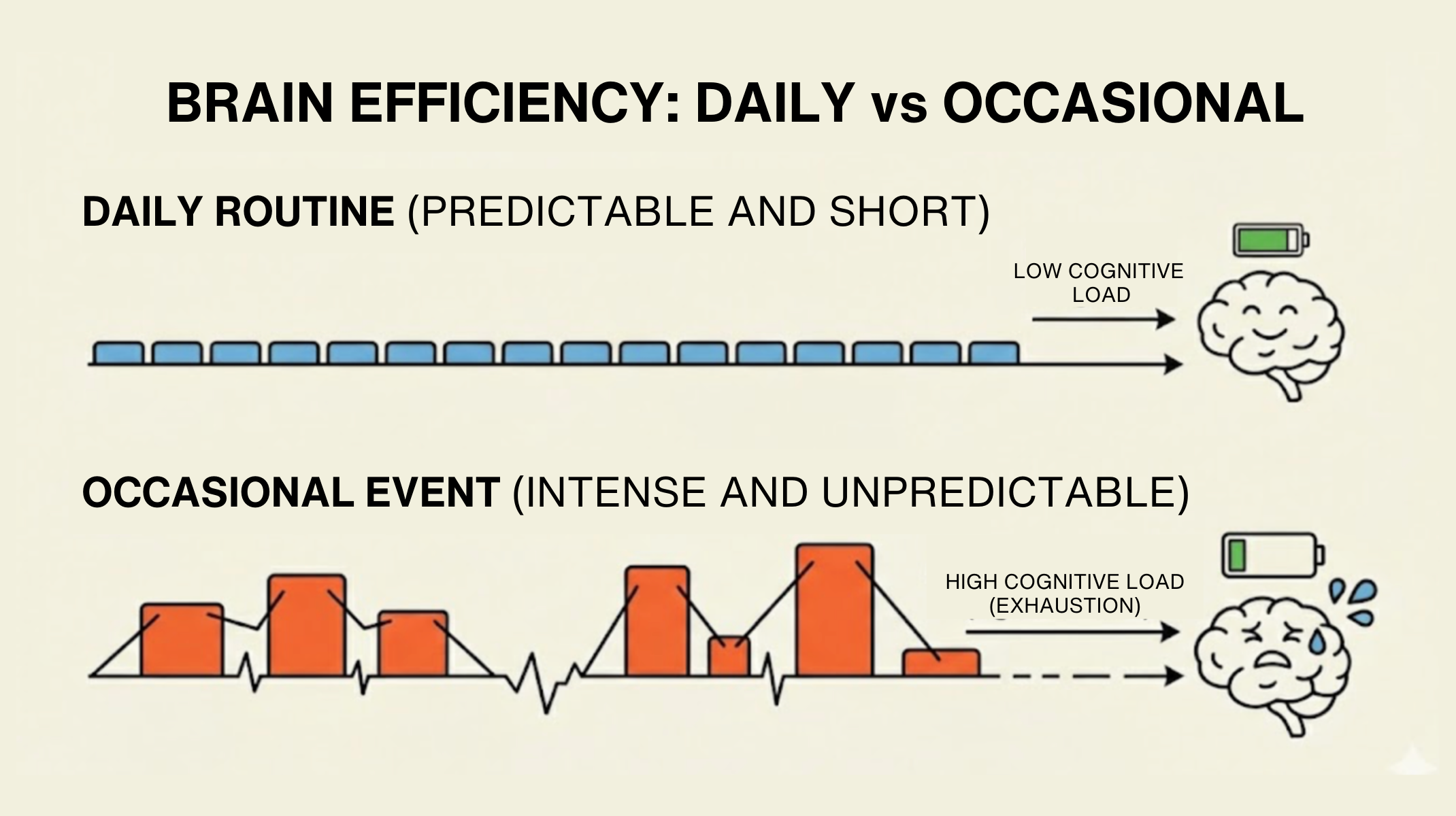
The Productivity Paradox: Why "Daily" is Easier Than "Occasionally".
There's a counterintuitive notion in time management: often, the solution to work overload isn't doing fewer things, but doing them more frequently.
It seems illogical. If you and your team are already drowning in meetings, suggesting a daily cadence sounds like punishment. However, behavioral science and operational experience demonstrate that daily consistency trumps sporadic intensity.
The Science Behind Habit: Cognitive Load.
The human brain seeks energy efficiency. Every time you perform a task that happens "occasionally" (like that dreaded weekly results review), your brain has to expend significant conscious effort. It has to "reset" the context, remember where it left off last time, emotionally prepare for the stress of the presentation, and muster the willpower to execute it. This consumes a lot of energy.
Conversely, what is done daily becomes ritualized. It shifts from conscious effort to subconscious habit. Think about brushing your teeth; it requires no willpower or prior preparation. It simply happens. In the workplace, transforming key processes into daily rituals drastically reduces the mental friction needed to initiate them.
The Weekly Meeting Trap.
I see this constantly with my clients. Their calendars are filled with recurring weekly meetings, each with a different audience, format, and stress level, because:
They disrupt workflow: They pull the team out of their productivity "zone."
They generate "busywork": Invaluable hours are spent "preparing for the meeting," polishing presentations, instead of solving real business problems.
They address problems too late: A weekly review means you're reacting to problems that may have arisen five days ago.
Initial Resistance and the Hidden Reality.
When I suggest implementing a daily meeting (like a Daily Direction Setting or DDS), the client's first instinctive reaction is rejection: "That's too many meetings!"
Here's the catch: they don't realize that by avoiding investing 15 to 30 minutes in a recurring, predictable, and structured meeting, they end up spending up to 6 hours a week in "emergency" meetings, putting out fires that got out of control because they weren't detected in time, or in endless review meetings where no one comes prepared.
The solution: The Daily Stand-up (DDS).
A well-implemented daily meeting is not a burden; it's a liberation. A robust operating system is based on two pillars:
The Daily Stand-up (DDS): A 15-30 minute forum. It's an operational space where the team reviews metrics (which, being daily, are worth automating, eliminating manual preparation) and answers only two questions: "What will you do TODAY to close the gap in your results?" and "What help do you need to overcome obstacles?"
The Structured Weekly 1:1: Eliminates presentation agendas. It's a sacred space for the employee to request support, coaching, and development.
Conclusion:
When something hurts in the operation, the instinctive response is to push it away. The smart response is to bring it closer and make it a daily practice. A daily cadence reduces anxiety, automates preparation, and focuses energy on immediate action, not on explaining the past. Stop relying on heroic weekly efforts and build predictable daily systems.